Wednesday, January 16, 2019


Timeline of Alfred Edwards
3rd Great-Grandfather
1791-1873

Year    Age   Facts

1791     0      Birth Virginia
1813    22     Marriage Abt. 1813 South Carolina or North Carolina, Mary Slay,    (1795–1840)
1814    23     Birth of Son Charles Edwards  8 June 1814 Chesterfield, South
Carolina (1814-1865)
1816    25     Birth of Son Thomas Edwards 18 Apr 1816 Chesterfield, South        Carolina (1816-1875)
1820    29     Residence: Bennet, Anson, North Carolina
1827    36     Captain’s District, Hays, District 13, Lee County, Georgia
1830    39     Residence: Dekalb, Georgia
1840    49     Death of Wife Mary Slay (1795–1840) AUG 1840 (?)
Cherokee, Georgia
1840    49     Residence: District 962, Floyd, Georgia
1850    59     Alfred Edwards is nowhere to be found
1855    64     Lowndes, Alabama
1860    69     Residence: Southern Division, Coosa, Alabama
1865    74     Death of Son Charles Edwards (1814–1865), 9 Sep 1865
Cherokee County, Georgia
1866    75     Residence: Alabama, USA
1867    76     Residence: Elmore, Alabama
1870    79     Residence: Township 20, Elmore, Alabama
1873    82     Residence: Central Institute, Elmore, Alabama
1873    82     Death: 10 MAY 1873 Elmore, Elmore County, Alabama
1873             Probate 15 Sep 1873 Elmore, Alabama


Sources
1820 U S Census; Census Place: Bennet, Anson, North Carolina; Page: 25; NARA Roll: M33_80; Image: 33
1827 District 13, Captain’s Hays District, Lee County, Georgia, Georgia Land Lottery
1830; Census Place: Dekalb, Georgia; Series: M19; Roll: 17; Page: 46; Family History Library Film: 0007037
1840; Census Place: District 962, Floyd, Georgia; Page: 247; Family History Library Film: 0007043
1860; Census Place: Southern Division, Coosa, Alabama; Roll: M653_7; Page: 128; Family History Library Film: 803007
1870; Census Place: Township 20, Elmore, Alabama; Roll: M593_15; Page: 156A; Family History Library Film: 545514
Ancestry.com. Alabama, Voter Registration, 1867 [database on-line]. Provo, UT, USA: Ancestry.com Operations, Inc., 2015
Probate Records, Wills and Minutes, 1866-1949; Author: Alabama. Probate Court (Elmore County); Probate Place: Elmore, Alabama
1865 U.S. IRS Tax Assessment Lists, 1862-1918
1867 Alabama Voter Registration Records

Friday, January 11, 2019

Researching the Common Surname Edwards


It is challenging to research an ancestor that has a common surname such as Edwards. It involves time and effort into researching others with the same surname who may or may not be connected to your Edwards line. That is a necessary step though to prove or disprove your line of Edwards. If you have details for your Edwards line this will help in narrowing the search and will lead you to search for records for your ancestor.

In 2012 my brother volunteered to YDNA test for our surname line.  When the results came back, I connected with a cousin who shared his Edwards and related families' information with me.  This information was valuable in jump starting research for the Edwards, Kelly, Slay, Teal, Wideman, and Baker family lines. There may be some challenges for researchers who have common surnames when trying to track down their ancestral lines. However, there are clues that have been used while researching my paternal line Edwards ancestors. Research began with Alfred Edwards and creating a profile for him using the information provided by my cousin. Detailed notes of Alfred Edwards was used to compare the information that my cousin provided with that of others with the same surname. His birth year, occupation, place of birth, spouse, and children’s names made it easy to identify Alfred Edwards from others with the same surname. There were other Alfred Edwards but they weren’t born circa 1791 in Virginia, with a wife named Mary “Polly.” They didn’t have sons with the names of Thomas and Charles. Creating a timeline of his life helped when looking at records. From those records I concluded that I had the correct ancestor.

Knowing the location for my ancestor was a help in narrowing the search and the people with the same name. Alfred Edwards migrated out of Virginia and died in Alabama so the timeline helped to see the places he lived, placing him in a certain area at a certain time. This allowed me to limit the search for Alfred Edwards in the locations within a given time period. This also helped in locating records for Alfred Edwards.

Alfred Edwards was a paternal third great grandfather. His descendant John Houston Edwards was my father’s biological father, my paternal grandfather and my great uncle. My father’s mother Alice Lee was the sister of John Houston’s wife Dollie Ophelia Lee. When I began researching there were several Alfred Edwards, but only one was found who was born circa 1791 in Virginia. Alfred Edwards was married to Mary Slay. Although a marriage record wasn’t found family stories has them getting married circa 1813 in Chesterfield County, South Carolina. It isn’t known by this researcher how many children they had; however, there are two known children Thomas and Charles. Alfred Edwards died on May 10, 1873, in Elmore, Alabama, having lived a long life of 82 years.

The Edwards family name was found in the USA, the UK, Canada, and Scotland between 1840 and 1920. The most Edwards families were found in the UK in 1891. In 1840 there were four hundred twenty-nine Edwards families living in New York. This was about 13% of all the recorded Edwards's in the USA. New York had the highest population of Edwards families in 1840.

Use census records and voter lists to see where families with the Edwards surname lived. You can see how Edwards families moved over time by selecting different census years. Within census records, you can often find information like name of household members, ages, birthplaces, residences, and occupations. What did Alfred Edwards do for a living? Alfred was a farmer.

In 1880, farmer, laborer and keeping house were the top three reported jobs worked by Edwards. A less common occupation for the Edwards family was farm laborer. The most common Edwards occupation in the United States was farmer. Thirty-nine percent of Edwards's were Farmers. 

The Edwards surname is a common English name and also common name in Wales. You can follow the migration of the Edwards family as they were enumerated in only two censuses that I have found. The 1860 and 1870 censuses. 

the 1860 census had valuable information about Alfred and his son Thomas. A.  Edwards is sixty-nine years old and living with Thos. Edwards age forty-four and Thos. was a physician. Thomas’s real estate value is $4000. And personal estate is $24,550.00. Thos. was born in South Carolina and attended school. There are ten other people living in the household. I did not recognize them. On the 1860 Rockford Post Office, Southern Division, Coosa County, Alabama, A. Edwards is a farmer with a real estate value of $1000.00 and his place of birth was Virginia.  His wife Mary “Polly” died about 1840 in Cherokee County, Georgia. Possibly she died after they left South Carolina headed west.

On the 1870 Township 20, Elmore County, Alabama census Alfred Edwards’ occupation was a farmer, with real estate of $400. And personal estate of $250. 00 states her birthplace is Virginia. He also states his father is foreign born and his mother is foreign born. That is a tip for me to look for immigration records for his parents. Alfred Edwards also states he cannot write. There is an Alfred Edwards listed on the 1870 Agriculture Census living in Township 20, Elmore County, Alabama.  The Agriculture Census was for the year ending June 1, 1870. The value of Alfred Edwards farm produce, including betterments and additions to stocks was $2050.00. The value of the animals that Alfred Edwards slaughtered or sold for slaughter was $235.00, and the value of home manufactures was $50.00. 

Research for Alfred Edwards produced fragments of a paper trail for this ancestor who lived a long and seemingly productive life. . I have exhausted all the records online for Alfred Edwards and haven’t found a marriage record, pre-1850, 1850 censuses, or land records for Alfred Edwards . Possibly he was born in England, Wales, or Ireland and brought to the colonies at a young age. On the 1870 census it stated his parents were foreign born so possibly they were the immigrant ancestors of the Edwards family line. 

Research is ongoing and as records are found information will be updated for Alfred Edwards. 

Wednesday, January 9, 2019

Using Record Sources Not Another Online Tree as Evidence

One of the advantages of people’s online public trees is that they can be helpful for folks like me who had very little information about a family line. My Lee family line has been a challenge and other people’s family trees have provided clues, records, and photos that I have used to guide to me as I searched for record sources to verify the information. Over fifteen years ago when I began my genealogy journey I had very little information on my grandmother Alice Lee’s family line. The only name that I ever knew my father’s mother by was “Granny Eley.” When I asked Granny her real name, she wouldn’t tell me, so I grew up never knowing her Lee/Meadows family. Thankfully my sister Ruby the oldest of the eight children knew about the family.

The information for my great grandfather William Alfred Lee was provided by my sister Ruby. Ruby gave me his name, place of birth in Alabama, his wife’s name, where they were married and who married them, and that they migrated from Alabama to Jackson Parish, Louisiana. This information was a great help in getting me started in researching the Lee line, but I was stumped when trying to link William Alfred to his father. William was supposedly born in 1847 but he wasn’t found on the 1850 census.

When I chose an online tree, I looked for errors and inconsistencies in the trees. I did not want to use a tree that had errors and inconsistencies in it. William A. was listed with his mother and his siblings on the 1860 Tallapoosa County, Alabama census. I later found out William Alfred Lee was born in Oct 1850 after the enumeration date May 1 for the 1850 census. I analyzed every record source for William Alfred Lee to make sure the names, date, and location were valid before adding him to my tree. I used those sources that backed up the information for my ancestor. Now, I know that the information is accurate (as it possibly can be) for my great grandfather.  Online trees provided the name of William’s father and there were record sources with them, so I used those records and researched until I was confident this was the correct ancestor.

Genealogists at one time or another have come across an online family tree with our ancestor in it and when we look at the tree the only source is another family tree. Family trees are not a valid source. What you are looking for is evidence or facts for an ancestor. A valid record source is one that supports the facts such as a birth certificate, marriage license, death certificate. You take the record source and analyze it to see if it is relevant to a particular ancestor that you are researching. You continue to collect sources for that ancestor and analyze them to see if it supports or contradicts the other sources. You are working to prove this person is your ancestor. You are looking for evidence of facts and information to support your research for your ancestor.

It is so much easier to just copy an ancestor and his family than it is to search for records and carefully review each record for proof, making sure the evidence from the record supports all the other information about the ancestor. If you think about it, another family tree doesn’t support any facts or evidence. The ancestor in the other person’s family tree may not be your ancestor. That is the reason for researching and finding record sources and analyzing them to prove that this is your ancestor.

Genealogy is about collaborating. Most genealogists share their trees on a public site. The information collected and shared in an online tree is valuable to other researchers. I am happy to share the information in my tree with others and I have worked diligently to make sure the information in my tree is verified with record sources. Whatever database you choose to share your family tree on it is your responsibility as a researcher to make sure the information you are collecting and sharing is accurate.

Keep in mind that an online family tree without sources is only to be used as a guide for further research. Search for record sources that prove the information and use those record sources to cite the information in your tree. You should ask yourself is the proof a valid record and not a compiled record, family book, or story, etc. Are the dates making sense that are listed in the tree? Are the children’s ages such that the person listed as a wife is too young to have children those ages?

Our goal is to have a family tree with record sources to prove the names, dates, locations, etc. in our family trees. If we all work diligently and use valid record sources as evidence in researching our ancestors, then cite the information in our trees with those record sources, the genealogy community will be better benefited due to our efforts.

Dr. Margaret Mead, 1901-1978
half-length portrait, facing right reading a book.
Library of Congress

Sunday, January 6, 2019

Why is DNA Testing Important for Family History and Why Should I DNA Test?


Those questions are often asked in meetings that I attend, and the answers vary depending on the person you talk to. DNA testing is a choice and there are many reasons someone will choose to test. Since I began DNA testing in 2012, I have tried to learn about DNA, how to interpret results, and how DNA test results will benefit a hobby genealogist. There are ways to continue learning about DNA testing and those that I benefit from are blogs by experts in the field and subscribing to those blogs, viewing webinars by genetic genealogist, attending genetic genealogy conferences, joining genetic genealogy Facebook Groups, and reading and studying any book that is available on the topic.

So why is DNA Testing important for family history and why DNA test? DNA testing is not a shortcut to traditional genealogical research. DNA testing isn’t a replacement for the paper trail. DNA testing is a record and is used in cooperation with traditional genealogical research. Genetic genealogy is a way for genealogists to go beyond what they learn from relatives or from historical records. As you look through your DNA test results there will be clues about where the cousins’ ancestors might have come from and clues about relationships between your families.

If you have been researching long you use records such as birth, marriage and death records in your research. Your DNA is a unique record of you and your family – your parents, your grandparents, and great grandparents. It is a record of your genetic family tree just as your genealogical family tree is a genealogical pedigree of your family. Look at it this way, you have two trees – a genetic family tree and a genealogical family tree. According to my Ancestry family tree I have sixteen hundred fifty-nine people in my genealogical family tree. I have my direct line ancestors and collateral ancestors with sources in this family tree. My genetic family tree contains those ancestors from whom I received DNA as it was passed down and it represents me and my family in a way that no other record can.

Whether or not you DNA test is a personal preference. It is solely left up to you and there is nothing that says you have to DNA test. You alone are the one who knows how important DNA testing might be for you. You might ask yourself, “Why DNA test? Do you want to learn about ethnicity estimates? DNA testing will give you that information.  What am I trying to learn from DNA testing?" If you have been researching for years, then DNA testing will help in verifying your ancestors and your research. There are some places where the documentation can't be found but finding a DNA match will let you know that you descended from that particular ancestor. DNA testing can help in a family line where you are stuck and can’t go any further with that line. Unless there is a misattributed parentage in the line DNA is a record for that family line where the paper trail ends. Even though there may be a misattributed parentage, if relatives from that line have tested there will be relatives show up in your match list from that line.

Another question to ask is, “What family secrets might DNA test results reveal?” Some people have gotten surprises when their DNA results comes back. There were secrets in families and some may have been revealed and shared down through the family; however, there were those that remained secrets. If you choose to DNA test prepare yourself for anything that may show up when you receive your results. If your results shows up with unexpected results it can be a shock if you haven’t prepared yourself.

DNA is a powerful record that is available for genealogists that is used to confirm our ancestors and the physical connection. You can connect with cousins and collaborate with those cousins and they may have information about family that you don’t have that will help fill in a gap in your research. DNA proves or disproves relationships.

Saturday, January 5, 2019

Saturday's Tip

Online Family Trees

You found an online tree that has your ancestor in it. You have been searching for this particular ancestor for a while but have been unsuccessful in finding him. Now that you have found him what do you do? You may ask yourself how do I know for sure this is my ancestor? First, is the information sourced? How do you know the information is correct? Look for gaps, inconsistencies, and conflicting information in the tree. The following list will help you as you look  through the tree.
  • Birth of a child before the mother was of childbearing age
  • Inconsistencies in christening locations
  • Mother passed childbearing age
  • Siblings too close in age
  • Inconsistent marriage date
  • Incorrect gender
  • Person beyond normal life span but not marked as deceased
  • Duplicate birth or death dates or places
  • Inconsistent surname spelling
  • Inconsistent place names
  • Married name entered as a maiden name
  • Siblings with same first name
  • Person duplicates
  • Persons not connected to others in tree
  • Connection between generations
Online trees are notorious for errors. Resist the temptation to just take the information and add to your tree.

The information from an online tree needs to be examined very carefully making sure it the correct information about your ancestor before using it in your tree. Every genealogist would like to have a robust family tree; however, you would like to have your ancestors not someone else’s ancestors in your family tree. You do that by searching for additional records for your ancestor following solid genealogical methodology and verifying the accuracy of the information you use in your family trees. 

No matter how long you have been doing genealogy it is always a good practice to continuously review your work, and when you scrutinize an online tree you are reviewing someone else's tree.  As you go along in your research always cite your sources and that saves time in the long run. If the online tree has sources you cite those in your tree if that is your ancestor.  This will help you trace back to where you found the information and verify whether your conclusions about your ancestor are true.  Other researchers will have confidence that your information is correct when you have records to back up your work. Sources are a great way to point you to family members such as an ancestor’s siblings. They also give you clues for further records and leads to more research.

Even the best genealogists have errors in their research. By checking for gaps, inconsistencies, and conflicting information in an online tree and following up with sources that backup the research will you build an accurate family tree.

Sunday, December 30, 2018

Census Sunday


Finding Your Ancestors in Censuses

Census records are a valuable resource for family historians. They have the potential for information that connects one generation to the next. Census records can reveal details about your ancestors and can give you a snapshot of their lives at a particular time in the past. When searching for your ancestor in the U.S. censuses verify the correct ancestor by looking at the whole family – his wife, children, parents, etc. Families migrated in groups and tended to keep close and stay together. As you collect information from the censuses about your ancestor you will see a profile emerge. As you look at a census compare it to the previous census. Take notice of any contrasting information and make note of it.
   
Family historians can access censuses from 1790 to 1940 and the information for each census year varies from census to census.  Information is a little more difficult to glean from censuses before 1850; however, if you have information for an ancestor such as birth information you can look to the head of the family, the age categories and estimated birth years and identify possible ancestors. I have an ancestor Jordan Lee who left only fragments of a paper trail and has been one of my most difficult ancestors to research. Jordan Lee has been listed on censuses in South Carolina in the area where Benjamin Hodge and John Rains (Jordan’s wife Lidia’s family) was listed. I have carefully looked through each census from 1810 to 1840 hoping to find a clue that will lead me to vital information about Jordan Lee.

Jordan Lee was either born in South Carolina or Ireland. It was important to remember the possibility that he was an immigrant to the colony of South Carolina and that he wouldn’t be named on records prior to 1810. The information that I had to begin my research came from Lee relatives. They have researched the Lee line and the information provided by them was vital in jump starting my research for my grandmother’s ancestors. Although I knew very little about my Lee ancestors. I used the information with sources that they provided, then verified it using records that were available. Censuses were found for Jordan Lee in 1810 to 1840, and he is named on a land record, estate record for Thomas Hodge, and a record for Benjamin Hodge, his father-in-law.  With this information about Benjamin Hodge, Thomas Hodge, and John Rains I kept a close eye on the neighbors or those people listed on the censuses with Jordan Lee. Also, I looked for any familiar names such as the brothers-in-law of Lidia Hodge Lee. Those names were clues when searching for Jordan Lee and that I had the correct ancestor.
As I looked at the 1810 Richland, South Carolina census I noticed in the left column the words Columbia town and Richland District were written down the side of the census. That caught my eye since there was not a heading on the census. The name of town, city, or county, names of heads of families, free white males, free white females, and all other persons were on page one and since my ancestor was on page 5 of the census, I had to refer to page one for the age categories. There is a Jordan Lee on the 1810 Columbia, Richland District, South Carolina census. His estimated birth year is 1778 and on the 1810 census is one free white male listed in the column that shows the age category of 26 and under 45 including heads of families. Jordan Lee would be about thirty-two years old at that time. Lydia his wife would have been about twenty-five years old. A free white female is listed in the age category of 16 under 26 including heads of families.

Since I had a location for Jordan Lee, I continued my search in Richland, South Carolina. Next was the 1820 census. I noticed on the 1820 census there were categories that I had not seen before.  The 1820 census shows additional information added such as: Number of foreigners not naturalized, Number of persons engaged in agriculture, Number of persons engaged in commerce, Number of persons engaged in manufacturing, and Number of slaves, Number of other free persons, except Indians, not taxed.
The 1820 Richland, Richland District, South Carolina census has a Jordan Lee listed on it; however, in the column that states “Foreigners not Naturalized” there is no check leading me to believe that he isn’t an immigrant. A male is checked in the age category of free white males of twenty-six and under forty-five including heads of families. There is a female in the same category for free white females and possibly his wife Lidia. One interesting note is Benjamin Hodge father of Lidia, wife of Jordan Lee, is listed on the census one page to the left of the page where Jordan Lee is listed. The column for “Foreigners not Naturalized” was not checked for Benjamin Hodge either, indicating to me that he most likely was born in the colonies.
I had difficulty reading the headings on the 1830 Richland District, South Carolina census so I used a blank 1830 census form to determine what information was in the columns. There is a mark in the of fifty and under sixty age category so possibly this is Jordan Lee and he would be about fifty-two years old at that time and a female with a mark in the same female age category. There are not any marks in the “Aliens – Foreigners not naturalized column.” Family stories passed down have said that Jordan Lee was a young boy when they immigrated from Ireland.  What is his father’s name? There are nagging questions that need to be answered.  First, did the census taker ask “Aliens – Foreigners” information? Second, was Jordan Lee an immigrate to the colonies? Lastly, what is his father’s name?

Each census question is answered by an informant (or someone who gave the information). That person was anyone who answered the door when the census taker came to the door. The 1840 U.S. Census requested persons who were “pensioners for Revolutionary or military services” to indicate that information. That information was not noted on the census for Jordan Lee and no military records have been found for him. That is a question that I have asked repeatedly but can’t answer since I haven’t found records for him.
Researching further I followed Jordan Lee to the 1840 census and found a Jordan Lee listed on the Tallapoosa County, Alabama 1840 census. He is listed in the free white persons including heads of families in the 60 and under 70 age category for males and there is a female in the 40 to 50 female age category. Lidia’s estimated birth year is 1785 therefore she would be about fifty-five years old. Is that female Lidia? Lidia Lee is listed on the 1850 Tallapoosa County, Alabama census living alone, she was born in South Carolina, she is sixty years old, and her estimated birth year 1790. Based on the previous censuses and the 1850 through 1870 censuses I concluded this to be Lidia Lee. There is a land record for Jordan Lee for 40.14 acres dated 1 June 1845 Tallapoosa County, Alabama. 


Although the question of whether or not Jordan Lee was an immigrant was answered by researching the 1820 through 1840 censuses there are questions about Jordan Lee that I will research to answer. Who are his parents? Did Jordan Lee serve in the military? He would have been about thirty-two years old when the War of 1812 was going on. What was his religious affiliation? I haven’t found church record for him. I continue to research and hope for more records to be added online that will help in answering these questions and others that might come up.

Sunday, December 23, 2018

Sunday's Censuses and More

The Life Story of Santa Clause

Now for all of you doubters of whether or not there really is a Santa Clause this is a fact, “there is a Santa Clause!” Santa Clause was born April 4, 1887 in Liberty, Saline County, Missouri, to William and Henrietta S. Clause. Missouri is a great place for him to be born because he didn’t have to travel from far to deliver all the children’s toys. The best I can tell is that Santa had nine siblings and their names were Emma, William, Pearl, Nellie, Earl and Harvey. Yes, I know this is a bit confusing for you since initially Santa employed six elves. But the more help available the better for Santa Clause! Right!

Santa's father tells the census taker that his father's birth place was Germany. If the family was of German descent this brings to mind interesting questions.  How was Clause pronounced in German? How did this family pronounce the Clause? Was the name originally Klaus? Or Claus? 
As you can tell from the census in 1900 Santa was living in Liberty, Missouri with his parents and siblings and he was thirteen years old. Both of Santa’s parents were born in Missouri. In 1910 Santa Clause was twenty-three years old and working as a hired hand on a farm, and still living in Liberty, Missouri. On June 9, 1912 Santa Clause found the woman of his dreams who would be a lifetime partner and a helpmate. As you can see on the certificate her name was Minnie Mabel Hill and they were married in Marshall, Saline County, Missouri.
 
He signed up for the draft and  he is listed on the U. S. World War I Draft Registration Card 1917-1918 living in Powers, Colorado on Lamar Route A. He states he is a natural born citizen of the United States. At that time, he was a farmer and employed by J. W. Paste. He was married and his wife and two  children living with him. He states he is a Caucasian. Contrary to what we all believe Santa Clause had light brown hair, medium build (not short and not heavy built), medium height, not tall and not short. His eyes were blue, and he wasn’t bald. And there was no mention of a white beard! I know that this is disappointing to us but that is his description of himself. Therefore, it is a fact!
Well, by 1920 he was back in Missouri living as a border in his brother Earl Clause’s household.  Dear old Santa Clause was thirty-one years old and living in Blackwater in Pettis, Missouri and the census states that he was single. Where is Minnie? Or is that a census taker’s error that he was single? He might have been; he might have been away working; they could have been separated at the time of the census taking; or he might have been divorced. We don't know his marital status at that time, so we just have to save the information on that census and continue our fact hunting of Santa Clause. 
Whatever the case in 1920 by the taking of the 1930 census Santa Clause was back in Saline County, living in Marshall on South Redman Avenue and he was married with six children living in his household with him and Mabel his wife. Santa Clause was a laborer working in River Construction and forty-two years old. Santa and his wife didn’t own a radio at that time. His home value was $15.00 so he most likely couldn’t afford a radio. Remember that one of the questions added to the 1930 census was do you own a radio?
On the 1930 census Santa’s age at the time of his first marriage was twenty-four years old. The census showed that poor Santa didn’t attend school; however; on the previous censuses it stated he was in school. His wife was giving the census taker the information and she probably didn’t know since she was busy taking care of her husband and seven children. How did I know that his wife gave the census taker the information for the census? On the census if there is an x looking mark by the person’s name, that is the person who gave the census taker the information for that household. Anyhow, Santa could read and write so, he either attended school or was self-taught. Santa’s occupation was a laborer in River Construction as shown on this census, so was he a minister or not? He possibly was a minister and just worked on the weekend and Wednesday for Wednesday night service. 
 
In 1940 Santa Clause is living on West Jackson Street in a house that he was renting and his house number was 796. He was no longer living on a farm near town. His occupation was a sewer man and the industry was drainage work in private work. That is what it stated on the census, and that would be a job where you get your hands dirty unlike his job as a minister. In 1936 though he worked sixteen weeks, and his income was $268.00. His wife didn't work outside the home and her employment as shown on the census was housework. Anyone who has a family as large as the Clause family knows housework is a full time job. It stated on the census that Santa had no other source of income and was looking for work. Mrs. Clause was not getting paid but she was most likely frugal with their resources. Santa was giving the census taker the information, and there was nothing stating that he was a minister. Maybe Santa had given up the ministry. His age on the 1940 census is fifty-two years. 
Santa Clause had three sons who signed up for the World War II Draft Registration. William Clause son of Santa's Army discharge card shows the person who will always know your address is Rev. Santa Clause, his father. During those war years families went through some difficult times so he probably was working and another job to support the Clause family.
In 1942 Santa Claus signed up for the World War II Draft Registration and he signed his name as Rev. Santa Claus. He was a minister in Saline County. He was fifty-four years old. This draft is what some call the “old man’s draft registration.” The question is was he a minister or not? Will look for records to determine if he was a licensed minister. This particular draft was needed in case they had to start calling up these men during World War II. I was conflicted as to why Santa Clause would be in Colorado in 1917-1918, well I concluded after analyzing the 1940 census and the World War II Draft Registration Cards for himself and his sons that he was a minister when he was living in Colorado. Why else would he be so far away from Missouri?  He lived in Missouri the remainder of his life.

His son Raymond Claus is shown as the name and address of person who will always know Rev. Santa Claus' address. On this form Santa's birth year is 1888; however, I am leaving the birth as 1887 since the 1900 had his birth year as 1887 this year was closer to the event and he was living in his parents household and the father gave the information to the census taker. 
In September 10, 1953 things were getting tough for dear old Santa Clause and and he was getting up in years so he went to the Social Security Office and made a claim. Santa was now sixty-five years old and had worked most of his life and was ready to retire. His social security number was 487161823. Santa Clause is ready to relax and enjoy life now. However, his retirement was short lived because in three years Santa Clause is dead. 
Santa Clause died at the age of sixty-eight in Marshall, Saline County, Missouri.  Was he ill when he retired? Did he die suddenly? If you look at the death certificate the cause of death is on there. Whatever his health was during those last three years Santa left a legacy. Santa Clause and Mrs. Clause had seven children and that is enough heirs to carry on his work. He had nine siblings so their descendants are left to continue what he started so many years ago. Santa is buried in the Blue Lick Cemetery in Saline County, Missouri where he lived most of his life. According to a comment on Ancestry from the contributor who shared Santa Clause's headstone, "The "E" was added to the headstone around 2005." He didn't know if the family added the "E" to the end of the surname or if the church officials. 

His death date on his Find A Grave memorial is April 1, 1957. Dates needs to be verified using other records. In his memorial it states his occupation: Retired Minister. Santa Clause is now at peace and can rest after all his many years of hard work and sacrifices as a laborer and minister. One can only surmise how shocked folks were when they heard that Santa Clause had died. His lifetime partner and helpmate Minnie Mabel Hill Clause died January 29, 1944 at the age of 49 in Marshall, Saline County, Missouri. 

This is the story of the life of Santa Clause. Now, do you believe there really is a Santa Clause?

Sources
1900-1940 United States Censuses
U.S. Social Security Applications and Claims Index, 1936-20007
Missouri, Marriage records, 19=805-2002
U.S. World War I Draft Registration Cards, 1917-1918
U.S. World War II Draft Cards Young Men, 1940-1947
U.S. World War II Draft Registration Cards 1942
U.S. Find A Grave Index, 1600-Current
Online Family Tree with sources as a guide in my research
Photo from Ancestry tree originally shared by wilmclause 4 Jul 2012


Santa Clause 

Monday, December 17, 2018

Maternal Monday

Nancy Caroline Hodges

Researching my Mother’s female maternal line ancestors has been challenging, especially since there are no family stories, family Bibles, photos, or records passed down to me. I have researched her maternal female ancestors infrequently and irregularly because of lack of information. I thought eventually there would be records added online for them, but they are limited for this particular ancestor – Nancy Caroline Hodges. However, honoring her in a blog post may touch one of her descendants somewhere who has information they are willing to share.

Nancy Caroline Hodges was born about 1819 in South Carolina. Online family trees are great sources to use if they have records to back up the information. If there are no records the trees are useless and unreliable. I took the information from family trees that had records and searched the records to verify the information. The research lead me to conclude that Nancy Caroline was the oldest child of Edmond and Martha Hodges, and that she married at a young age to my second great grandfather, John Lewis Coon born October 6, 1814 in Pike County, Mississippi. The 1820 Pike County, Mississippi has Edmond Hodges head of the home, and listed is one female under ten. One male twenty-six thru forty-four, one male under ten, and one female sixteen thru twenty-five.

Listed on the same 1820 Pike County, Mississippi census is Jacob Coon, father of John Lewis Coon, Wm. Hodges, Sidney Hodges, Jesse Hodges, Drure Hodges along with Edmond Hodges. I have concluded that Drure Hodges is the likely father of Edmond Hodges since Drure’s age was forty-five and up. Drure is listed living in the next household near Edmond on the census. There was a white female forty-five and up also listed. Therefore, I concluded these are the parents of Edmond Hodges. Jesse, Sidney, and William all had children listed in various age categories on the census. Those three Hodges males could be brothers of Edmond. I haven’t found Edmond on the 1830 census; however, he is on the 1840 census living in Pike County, Mississippi.

Listed as head of the family is one male in the fifty thru 59 age category and I concluded that would be Edmond. Edmond’s age in 1840 would be about fifty-one years. There is one female in the 40 thru 49 age category and I conclude that is Martha his wife since she would be about 56 in 1840. There were two males in the five thru nine age category, two females under five, two females ten thru fourteen, and one female fifteen thru nineteen which I concluded to be Nancy Caroline. I continued my research and found Edmund Hodges still living in Pike County, Mississippi and place of birth in South Carolina and age sixty-one. That would make his estimated birth year 1789 so I believe that I have the correct Edmond Hodges father of Nancy Caroline.

By the time of the enumeration of the 1850 census Nancy Caroline was married and she and Lewis Coon had five children. There is Martha M. (Miranda) eleven-years-old living in the household, so Nancy Caroline’s estimated marriage is about 1838. Nancy Caroline’s age is twenty-eight making her estimated birth year 1822. Sarah J. the next daughter was eight years old making her estimated birth year 1842. John C. age seven, Talitha age five, William C. age 4, and Edmund T. age 2. Their family continued to grow and by the 1860 census they were still living and Pike County and had three additional children – Polly Ann age nine, Isham age seven and Phillip age one.

Finding the Coon family in the 1870 census was more difficult. The tip to keep in mind when researching the censuses is to look at all spelling variations and initials. Well, Caroline was listed on page 29 on the census as N. C. Coon and was forty-eight years old and her place of birth was South Carolina. She had a real estate value of $200 and personal estate at $500. Living in Dwelling No. 219 was N. C. Coon and living with her were I. S. Coon male age seventeen, Polly female age sixteen, Phillip H. male age ten, Summers Vic female age twelve. Living nearby Dwelling 220 was E. T. Coon her son and his wife Jane A. Then, living in Dwelling 221 was Martha Miranda (M. M. McDavid) and her family.

Lewis Coon was listed as L. C. and was living with W. C. age twenty-three. In Lincoln County. I tracked the family down by looking at various spellings of the name variations. The other tip when looking through censuses is to look at the pages to the right and pages to the left of the page where you find your ancestor. That is the tip that I used and looked on the next page 30 and found L. C. (Lewis). On the 1870 census living in Dwelling 214 was Martha Hodges age seventy-five Nancy Caroline’s mother her place of birth was South Carolina and her value of real estate was $500 and personal estate $125.

On the 1880 census Caroline was sixty-one years old and Lewis was sixty-five. H. Phillip was living at home and he was twenty-one years old and the family was living in Lincoln County. Lincoln County was formed from Pike County in 1870. The family didn’t move the county line changed. 

After researching the available records and analyzing them carefully I feel confident that Nancy Caroline Hodges’ father is Edmond Hodges and her mother is Martha. Nancy Caroline died October 2, 1897 in Lincoln County, Mississippi and is interred in McDavid Cemetery in Lincoln County, Mississippi. John Lewis Coon died February 19, 1898 and is interred in the same cemetery where is beloved wife Nancy Caroline is interred.

Sunday, December 16, 2018

Sentimental Sunday

Lillie Dorothy Lavada Coon Age 16
Yearbook Date 1953 Thomas Jefferson High School 


Lillie Dorothy Lavada "Bobbie" (Coon) Underhill

Saturday, December 15, 2018

Sympathy Saturday


Jimmy Dale Lee 
July 2, 1942 - January 14, 2016


Jimmy Dale Lee, 73 of El Dorado, passed away Thursday, January 14, 2016, at the John R. Williamson Hospice House.

He was born July 2, 1942, to Axion H. and Nola Mae Evans Lee in Oak Grove, LA. He was the Owner of Lee’s Trucking and was of the Baptist faith.

Preceding him in death are his parents; son, Guy Dale Lee; one sister and two brothers.

Survivors include his wife of 55 years, Patsy Lee; two daughters, Lisa Owens (Toby), Tonya Chadwick all of El Dorado; six grandchildren, Jessica Lee (Jamie), Brandy Gaffney (Gary), Kristi DeTraz (Kyle), Cheryl Williams, Cody Chadwick, Chasity Chadwick; and nine great grandchildren.
Funeral services will be held at 3:00 p.m. Sunday, January 17, 2016, at Young’s Chapel under the direction of Young’s Funeral Directors with Bro. J.D. Weido officiating.

Memorials may be made to St. Jude Children’s Research Hospital, 262 Danny Thomas Way, Memphis, TN 38105; or to the Arkansas Children’s Hospital, 1 Children’s Way, Little Rock, AR 
72202.

Source

Dignity Memorial Funeral Home https://www.dignitymemorial.com
______________________________________________________________________

Jimmy Dale Lee was born in Oak Grove, West Carroll Parish, Louisiana to Axiom Harrison and Nola Mae (Evans) Lee. Jimmy Dales’ father was known by the nickname Tack. Tack was daddy’s first cousin. Axiom Harrison “Tack” Lee’s father was James William Lee and his mother was Nancy Matilda (Winn) Lee. Tack was one of fourteen children of James and Nancy.

Jimmy Dale was a second cousin on my paternal Lee family line. I was looking for a male Lee cousin who would submit a sample for YDNA testing so that I could verify our Lee patrilineal line. When I was looking for a Lee male cousin to YDNA test he gladly volunteered to submit his sample. I called him to set up a meeting at the Cracker Barrel Restaurant and took the cheek swab before we ate a delicious meal. Then, we then had an interesting conversation about family and growing up in West Carroll Parish. Jimmy Dale was the type of person that was interesting to talk to and one felt at ease with him, and he could tell family stories that made you feel as though you were there when the event was happening. We chatted a while then we went our separate ways and I didn’t see Jimmy Dale again before he died. I was surprised when I heard of his death since he looked to be in good health when we had our visit.

Well, I submitted his sample for testing and the results came back and I was shocked. There were no matches to the Lee YDNA 67 marker test results. I mistakenly thought there would be several matches since the Lee surname was so widely used. There are the Lees from Virginia; everyone has heard of Robert E. Lee; the Lees from North Carolina, the Lees from South Carolina, the Lees of Maryland, Pennsylvania, Washington DC, and Florida to name a few of the Lee families in America. My Lee family doesn’t link to any of those Lees. My patrilineal Lee is in a subgroup alone and from England. Eventually after a two year wait a match came back and the two share a common ancestor Jordan Lee; however, I am hoping more Lee descendants of this patrilineal line will YDNA test at least at the 37-marker level.

I am grateful to Jimmy Dale for volunteering for the Lee project.  He has passed on, but his DNA is stored in the Family Tree Testing Company lab.

Friday, December 14, 2018

Friday's Sentiments

Gone but not forgotten

Dorothy Lavada “Bobbie” Coon was my double first cousin and was born to Irma Kamile Coon my father’s sister, and her father was Morris Clifton Coon brother my mother’s brother. Bobbie as her family and cousins called her, was born 5 September 1934 in Lake Providence in East Carroll Parish, Louisiana the second child of Irma and Morris. Morris Clifton was the oldest child of Clifton and Lavenia “Venie” Coon, and Irma Kamile was the second child of Alice (Lee) Eley. My cousin Bobbie and I were unable to visit while growing up since we lived so far apart. West Carroll Parish, Louisiana and Jefferson County, Texas were miles apart. Bobbie’s father was born and reared in Brookhaven in Pike County, Mississippi. His mother died mysteriously about 1926 and the family was working through their loss. Sometime after her death the family migrated from Mississippi and headed west.

The Coon family migration from Brookhaven in Pike County, Mississippi was after the 1920 census since the family was enumerated on the 1920 census. By April 1, 1930 census enumeration they were living in Ward Four, West Carroll Parish, Louisiana surrounded by Coon and related families from Mississippi.

In 1930 Morris Coon was twenty-one years old living with his Uncle E. “Edward” M. Coon, Clifton’s (his father) brother and cousin Henry Hampton. As I looked at the West Carroll census, I noticed the majority of people living around the Coon family were from Mississippi. Why was that? Life in Mississippi was difficult after the Great Depression. Agriculture was the main income for the majority of the residents living in Mississippi. My Coon ancestors were all farmers with a limited education. There was widespread unemployment, poverty, and lack of food for some families during the Great Depression years. One of the questions on the census was did the family own a radio and the Coon family didn’t own one. Industrial jobs were also impacted by the Great Depression. During those years there was a serious racial divide in the state. Rural schools were affected by the economic difficulties during the 1930s and children suffered because of lack of funding. Most rural families couldn’t afford supplies and were unable to attend school throughout the 1930s explaining why so many of my ancestors had a limited education. I noticed on the 1930 census that Uncle Morris could read and write but he had no school. However, as I looked back at the 1920 District 92, Ruth Precinct, Lincoln County, Mississippi census Uncle Morris had attended school, and he was eleven years old at that time.

Social services in Mississippi during the 1930s were almost non-existent so families had nowhere to go for help. Folks in Mississippi weren’t the only ones suffering all America was experiencing nationwide suffering and deprivation in the 1930s. In 1935 America was dealing with the Great Depression and inching towards World War II. All the events were reasons families were leaving small town Brookhaven in Pike County, Mississippi looking for better opportunities.

Then, by 1935 they were in West Carroll Parish, Louisiana. On the 1940 census Morris Coon was thirty-one married and had three children living in his household. Mary Alice’s birth year was conflicting with the other dates in my mind and I couldn’t understand how the children were born in East Carroll Parish and they were living in West Carroll Parish. True that East Carroll borders West Carroll Parish and Ward 4 is in close proximity to Lake Providence, but I had to resolve these dates and where they were living. It was time for a courthouse research road trip. I made a trip to the courthouse in Oak Grove to research. I hit the jackpot! I found marriage records on several family members including Morris Coon and Irma Ealy (Eley). That was one of those genealogical aha moments when I found those marriage records! I examined Morris Coon and Irma Eley’s marriage certificate and discovered they were married in Oak Grove, September 27, 1930 after the April 1, 1930 census was taken. Therefore, I determined they moved to East Carroll Parish after they were married. The family was living in on 120 Hudson Street, Ward 3, Lake Providence in East Carroll Parish, Louisiana. Dorothy Lavada was six years old on the 1940 census, Aunt Irma was twenty-nine, Mary Alice eight years old, born in 1932, and David Lloyd was three. The census taker listed David as a daughter. This is an example of why it is important to carefully analyze records and verify information found on them. That is the place they were living in 1935 also. Uncle Morris’s occupation was listed as an Ind wood salesman and the industry was firewood. Aunt Irma wasn’t working at that time. They were renting their home at that time and paying six dollars monthly. Prior to the census he worked forty hours. He was self-employed. Mary Alice was in the second grade and Dorothy Lavada and David Lloyd hadn’t started school. 

The next record that I searched for to track the family to determine where they were living was the U.S. WWII Draft Card for Young Men 1940-1947. The Morris Clifton Coon family were still living in Lake Providence in East Carroll Parish when Uncle Morris registered for the draft. He was thirty-one years old, so he possibly signed up in 1940 since he was listed as thirty-one years old on the census. He was born 7 November 1908 in Pike County, Mississippi. I searched for a Social Security Application form for him but couldn’t find one; however, on the Social Security Death Index it show he signed up before 1951.

He apparently signed up for Social Security sometime before 1951 in Louisiana. Therefore, I concluded he signed up and his Social Security card was issued in Louisiana before leaving East Carroll Parish.

The 1950 census has not been made public yet, so I had to look at other sources to track the family’s migration. Five years ago, I made a trip to visit my cousin, Bobbie’s oldest sister, for an interview. She gave the details of their journey from East Carroll Parish to Port Arthur. The trip from Louisiana to Texas was a long difficult journey. Mary Alice said she was in school when they moved from Louisiana and that Uncle Morris worked along the way. Mary Alice said her parents placed her in school wherever they stopped for Uncle Morris to work. They were traveling by automobile and headed west. She said she went to a few schools along the way. She is now eighty-six years old and her memory is unable to recall facts from that long ago. After, interviewing Mary Alice I continued searching for records for Morris and Irma Coon.

By 1953 Morris and Irma were divorced and Morris had a son Morris Clifton, Jr born 12 May 1954 in Santa Monica, California. Morris Jr. died 1 Jan 2003 in Los Angeles California. Emma Delvin Copes was Morris Clifton’s second wife and mother of Morris Jr. In 1953 Morris and Irma’s daughter Lillie Dorothy Lavada Coon was about sixteen and her picture was in the Thomas Jefferson High School Yearbook. Dorothy Coon was listed in the 1953 Port Arthur, Texas City Directory living 2220 Seventh Avenue and listed as a student. Neither of her parents were listed in the directory.

Then 12 June 1954 Lillie Dorothy Lavada “Bobbie” Coon married George Joseph Underhill. They married in St. Joseph’s Catholic Church in Port Arthur. Father Crosswaite officiated. Like most newly weds they were happy and began their lives as a couple. The marriage record for the couple shows that Bobbie’s name was Lillie Dorothy Lavada Coon. Where did the given name Lillie come from? I don’t know. I only knew her by the name Bobbie. I recall that she had pretty red curly hair and she was pretty. When I discovered picture in the yearbook, she looked like I remembered her.

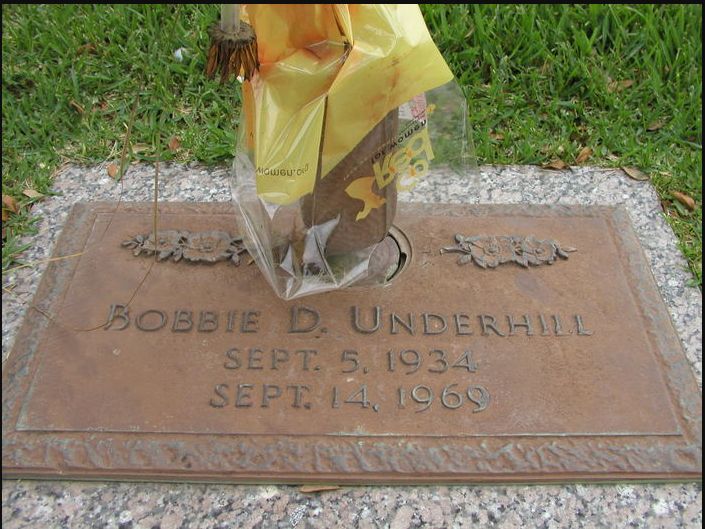
Morris, Irma and Bobbie are all three gone now but they aren’t forgotten. Memories of them are etched in the minds of their loved ones. Aunt Irma was my favorite aunt out of all the aunts on both sides of the family. She was a kind generous person. In my mind’s eye from when I was a young girl she always was dressed to perfection. She made several trips to Louisiana to visit family, and when I heard she was coming I very excited. My mother from the family stories I’ve heard took care of her brother Morris. He died of cardiac arrest on 8 March 1977 in Silsbee, Hardin County, Texas. Irma Kamile died 7 Dec 2001 in Port Arthur, Jefferson County, Texas. Bobbie their beloved daughter died at the young age of thirty-five 4 September 1969 in Port Arthur, Jefferson County, Texas leaving behind her five children and a family who loved her and misses her to this day.

Bobbie leaning out the window. Uncle Morris with the cigarette 
hanging out his mouth. Aunt Irma was taking the picture. Uncle 
George in the uniform. This photo was taken in Feb 1944 in 
West Carroll Parish, Louisiana. Picture from the author's 
private collection. 

Thursday, December 13, 2018

Traditional Genealogy and Genetic Genealogy

Everyone at some point in life have thought about the origins of their families and have got involved in genealogical research to learn about their family’s origin. When I began researching family over fifteen years ago there was lots of legwork in researching family. Trips to libraries, courthouses and cemeteries where our families lived was a laborious task but one where research skills were honed and over time you became an experienced genealogists. When preparing for research trips to courthouses it took planning to be successful in searching the records. It is important to learn such things as the hours, what department to go to once there at the courthouse, what records are there, where they are located, how to find them. You also need to know what you are allowed to bring in whether a camera, iPhone, small scanner, or if they makes copies of the records and the cost of each page. As you walked cemeteries you learned the layout of the cemetery plots, how to look for family, and folks connected to them. Today with all the large record collections online those days are all but gone. However, there are search tips you need to know to have successful online searches.

Entertaining ad campaigns for DNA testing companies have made the public aware of DNA testing for genealogy and increased public interest in genetic genealogy. Genealogical DNA testing is an essential tool for genealogical research. People are interested to learn about their genetic ancestry and their family origins. One of the misconceptions people have is they no longer need to do the research that the DNA will tell them everything.


Traditional genealogical research is a needed tool along with DNA testing to determine relationships between individuals and identify family lines. When you use DNA testing it is helpful to test multiple descendants of an ancestor, so you will need to document as many descendants of an ancestor as possible using traditional research. You will be researching the parents, their children, and their descendants and documenting your research as you go along. DNA testing prices are now affordable, and a useful tool used to connect to living cousins and the cousin matches will increase as long as DNA testing continues to gain in its popularity. 

Reasons for getting involved in genealogical research and genetic genealogy varies depending on who you talk to. I became interested in genealogy research when I asked my Mother about family and she knew very little about her family or Daddy’s family. Not knowing about the Coon or the Eley families set me on a quest to learn about family and where our origin began. Then, when DNA testing for genealogy was made available, I got involved in it to prove or disprove family stories and to verify family lines. Using DNA test results to identify living relatives is both complex and challenging but worth the time and energy. The rewards come when finding new cousins and collaborating with them to identify our common ancestor couple. 

DNA test results is a tool in the family researcher’s toolbox, but it is an evidence-based tool. One that all serious genealogists needs in their toolbox along with traditional genealogical research.
Dorothy Lavada "Bobbie" Coon married 
George Joseph Underhill 12 Jun 1954. From
the author's personal collection.